How to Plan the Camino de Santiago: Routes, Stages, Budget and Packing
Plan your Camino de Santiago step by step: choose a route, set your daily stages, get the credential and Compostela, budget for 2026 and pack under 8 kg.
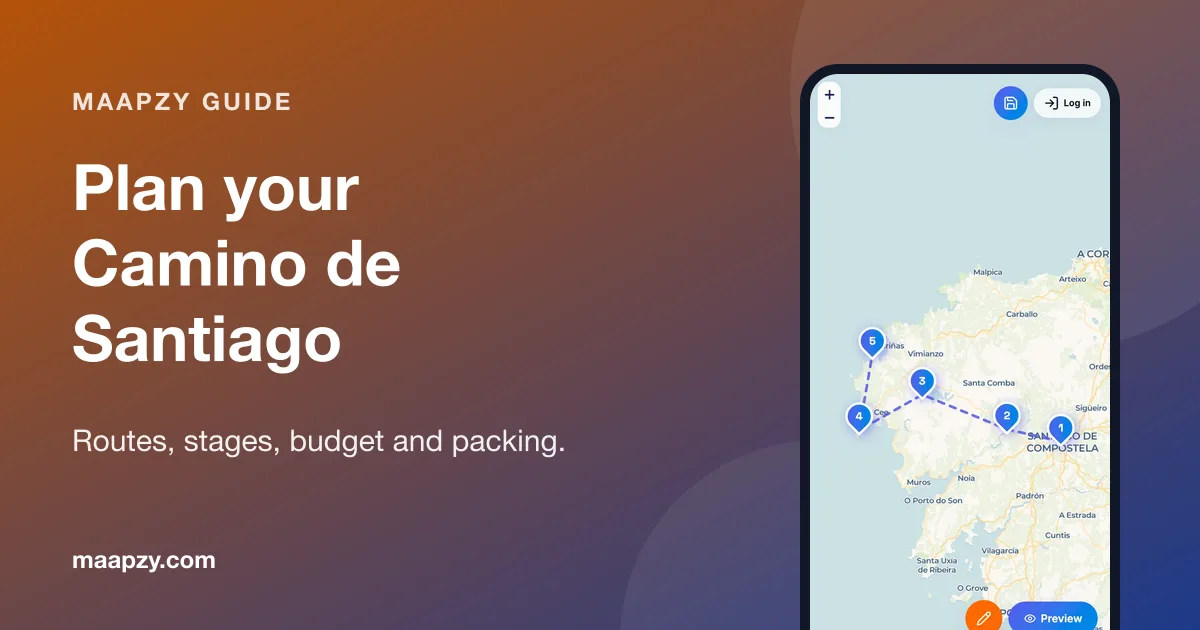
The Camino de Santiago is a network of old pilgrim routes that all end at the cathedral in Santiago de Compostela, in Galicia, north-west Spain. Hundreds of thousands of people walk part of it every year, for faith, for a break from screens, or simply for a long walk with good food at the end of each day. You don't need to be an athlete or religious. You do need a bit of planning.
1. Choose your route
- Camino Francés (about 780 km, 30–35 days): the classic, with the most pilgrims and services. See our Camino Francés guide.
- The last 100 km from Sarria (about 115 km, 5–7 days): the shortest walk that earns the Compostela. See walking the Camino from Sarria.
- Camino Portugués (about 240 km from Porto, 10–13 days): flatter, with Portuguese towns and a river crossing into Spain. See our Camino Portugués guide.
- Camino del Norte (about 820 km from Irun, 32–35 days): along the green northern coast, hillier and quieter. See our Camino del Norte guide.
- Camino Primitivo (about 320 km from Oviedo, 12–14 days): the oldest route, through the mountains of Asturias and Lugo.
- Camino Inglés (about 120 km from Ferrol, 5–6 days): a short route that also qualifies for the Compostela.
2. Work out how long you need
Most walkers cover 20–25 km a day. Fit, experienced hikers manage 30 km, but the first week is not the time to prove it. Add one rest day per week on longer routes, plus a travel day at each end.
If you can't take five weeks off, you have three good options: walk the last 100 km, walk a different section each year, or choose a shorter route like the Portugués from Tui or the Inglés. Many people walk the Francés in stages over several years, collecting stamps in the same credential.
3. Get the credential and earn the Compostela
The pilgrim credential (credencial) is a passport you stamp at albergues, churches, cafés and town halls along the way. It gives you access to pilgrim hostels and proves your walk. Get one from the cathedral, a pilgrim association at home or the start of your route; they cost a few euros.
To receive the Compostela, the certificate issued by the Pilgrim's Reception Office in Santiago, you must walk at least the last 100 km (or cycle the last 200 km) and collect at least two stamps a day on that final stretch. Non-religious walkers can receive a separate certificate of welcome.
4. Decide where to sleep
- Public albergues: shared dorms run by towns or the regional government, often the cheapest beds on the route.
- Private albergues: dorms and small rooms, usually bookable, often with kitchens and laundry.
- Pensiones, hostales and hotels: private rooms for a better night's sleep, especially useful from Sarria in summer.
On busy routes in summer, book at least the next night ahead. Out of season, many albergues close, so check what's open before you set off.
5. Budget for 2026
As a rough guide for 2026, budget €40–€60 per person per day if you sleep in albergues and eat a pilgrim menu (menú del peregrino, a set dinner with wine) in the evening. With private rooms every night, plan on €80–€130 a day. Our guide to travelling on a budget has more ways to stretch your money.
Luggage transfer services, including one run by Correos, the Spanish post office, can carry your bag between stages for a few euros a day if your back needs a break.
6. Pack light
Aim for a pack of 6–8 kg, or no more than about 10% of your body weight. Every extra gram is felt by day three. Our guide to packing light covers the system in detail.
- Shoes or boots you have already walked at least 100 km in
- Two sets of quick-dry walking clothes, plus one for the evening
- Merino or synthetic socks, and blister plasters
- Rain jacket or poncho; Galicia is green for a reason
- Sleeping bag liner (or a light bag outside summer), headlamp, earplugs
- Sun hat, sunscreen and a 1-litre water bottle
7. Train your feet, not just your legs
Blisters end more Caminos than fitness does. In the two months before you go, take longer and longer walks in the shoes and pack you'll use, including back-to-back days of 15–20 km. Stop and treat hot spots as soon as you feel them, and air your feet at lunch.
8. After Santiago: Finisterre and Muxía
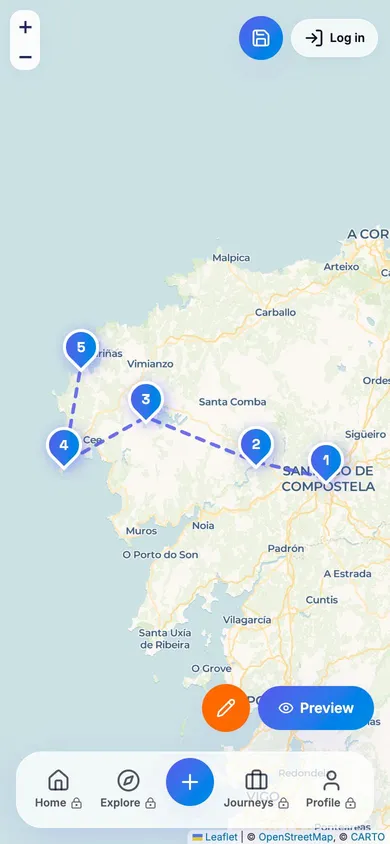
Many pilgrims keep walking to the Atlantic. The route from Santiago to Fisterra, once thought to be the end of the known world, is about 90 km and takes 3–4 days, with an optional extra day to Muxía and its seaside sanctuary. Both towns issue their own certificates. Plot it in Maapzy as a second journey so your whole Camino sits on one map.
9. Plan ahead for the 2027 Holy Year
When 25 July, the feast of Saint James, falls on a Sunday, it's a Holy Year (Año Santo or Xacobeo), and the cathedral opens its Holy Door. The next one is 2027, and routes will be busier than usual all year. If you're walking in 2027, start planning early, book beds ahead in summer and consider spring or autumn. Add the Camino to your bucket list now so the dates don't slip.
Camino planning checklist
- Choose a route and the number of days you have
- Plan daily stages of 20–25 km, with a rest day each week
- Get a pilgrim credential before you start
- Collect two stamps a day in the last 100 km
- Book the first nights and anything from Sarria in summer
- Budget €40–€60 a day in albergues
- Pack 6–8 kg and break in your shoes
- Map your stages in the planner
Frequently asked questions
How long does the Camino de Santiago take?
It depends on the route. The last 100 km from Sarria takes about 5 days, the Camino Portugués from Porto about 10–13 days and the full Camino Francés about 30–35 days.
Do I need to be religious to walk the Camino?
No. People walk for many reasons. Non-religious walkers who complete the last 100 km can receive a certificate of welcome instead of the Compostela.
How much does the Camino cost per day?
As a rough guide for 2026, €40–€60 a day sleeping in albergues and eating pilgrim menus, or €80–€130 with private rooms.
What is the easiest Camino route?
The last 100 km of the Camino Francés from Sarria and the Camino Portugués from Tui are the shortest and gentlest ways to earn the Compostela.
Sources
Start your next trip on a map.
Pin a few cities and see what a realistic route looks like — in five minutes, for free.
Open the plannerKeep reading
- Camino Francés: Walking 780 km From Saint-Jean-Pied-de-Port to SantiagoA stage-by-stage Camino Francés itinerary from Saint-Jean-Pied-de-Port to Santiago: the Pyrenees, Pamplona, the meseta, León and Galicia in about 5 weeks.
- Walking the Last 100 km of the Camino: Sarria to Santiago in 5 DaysWalk the last 100 km of the Camino Francés from Sarria to Santiago in 5 days: stages, distances, where to sleep, the two-stamp rule and getting to Sarria.
- Camino Portugués From Porto: A 12-Day Walk to SantiagoA 12-day Camino Portugués itinerary from Porto to Santiago via Barcelos, Ponte de Lima, Tui and Pontevedra, plus the coastal route and Spiritual Variant.