Camino Portugués From Porto: A 12-Day Walk to Santiago
A 12-day Camino Portugués itinerary from Porto to Santiago via Barcelos, Ponte de Lima, Tui and Pontevedra, plus the coastal route and Spiritual Variant.
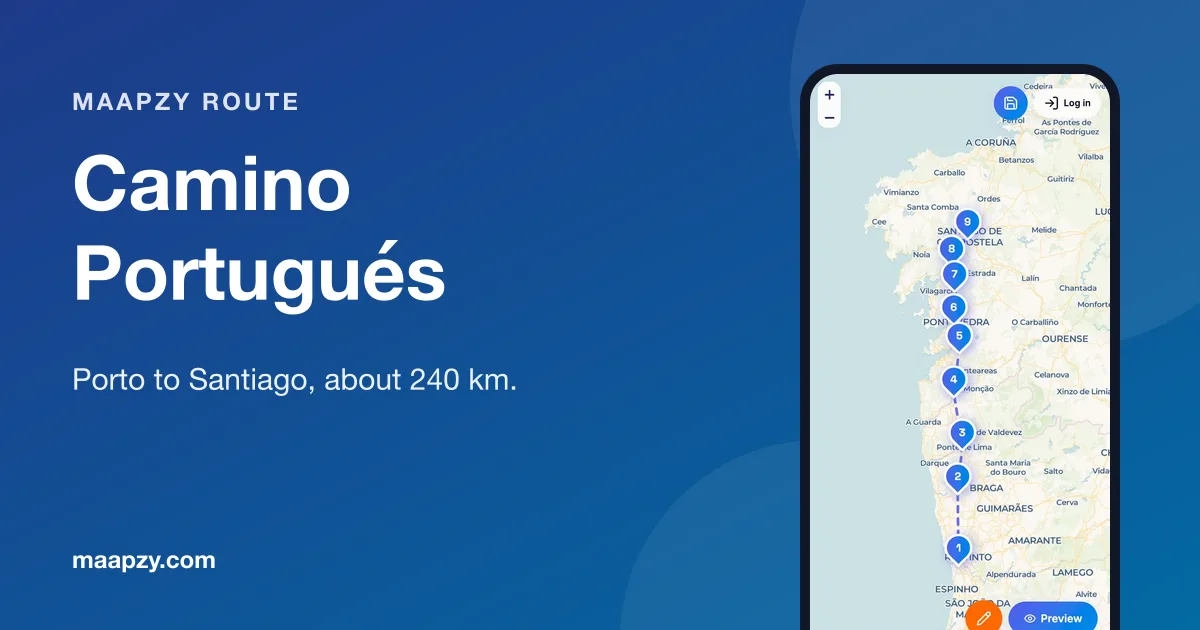
The Camino Portugués is the second most popular Camino route and a good choice for a first one. It's gentler than the Francés, with one real climb, and it links two countries in under two weeks. You'll eat pastel de nata at the start and pimientos de Padrón near the end. Spend a day or two in Porto first; our Porto local spots guide has ideas.
The route at a glance
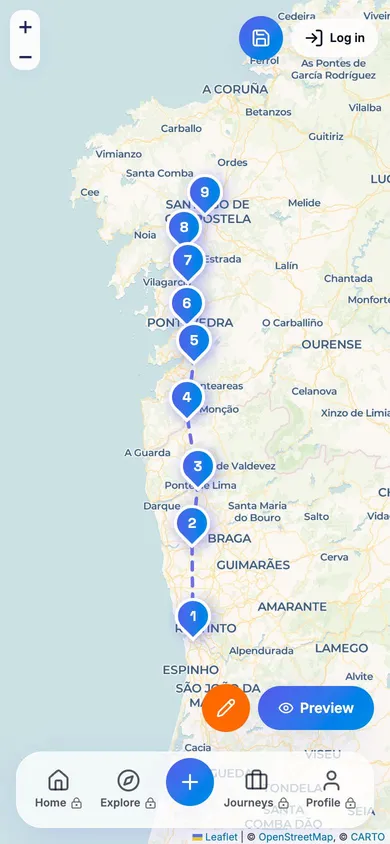
- Days 1–3: Porto to Ponte de Lima — via Barcelos (about 90 km)
- Days 4–5: Ponte de Lima to Tui — over the Labruja hills and into Spain (about 38 km)
- Days 6–8: Tui to Pontevedra — via O Porriño and Redondela (about 52 km)
- Days 9–11: Pontevedra to Santiago — via Caldas de Reis and Padrón (about 65 km)
- Day 12: a spare or rest day
Coastal or central?
From Porto you can choose two main paths. The central route runs inland through historic towns and is better served with albergues. The coastal route follows the Atlantic through Vila do Conde, Viana do Castelo and Caminha, crosses into Spain at A Guarda and continues via Baiona and Vigo to join the central route at Redondela. It's about 40 km longer and has more beach-town prices in summer.
This guide follows the central route. Either way, the first day out of Porto's suburbs isn't the most beautiful. Many walkers take the metro or a train to the edge of the city and start walking from there.
Days 1–3: Porto to Ponte de Lima
Get your credential and first stamp at Porto Cathedral (the Sé), then head north through farmland and small villages to Barcelos, a market town famous for the legend of the rooster. The story goes that a roasted rooster stood up and crowed to prove a pilgrim's innocence, which is why you'll see colourful ceramic roosters all over Portugal.
Ponte de Lima, one of the oldest towns in Portugal, sits on the river Lima with a long medieval bridge. Stay a night or two; it's one of the prettiest stops on any Camino. For more of the region, see our northern Portugal itinerary.
Days 4–5: Over the hills to Tui
Leaving Ponte de Lima, the path climbs through woods to the Alto da Labruja, the highest point of the route at about 400 m. It's steep but short. After a night in Rubiães, you reach Valença, a walled fortress town, and cross the iron bridge over the Minho river into Tui, in Spain.
Change your watch
Spain is one hour ahead of Portugal, so you lose an hour when you cross the bridge.
Days 6–8: Tui to Pontevedra
Tui's fortress-like cathedral watches over the river. From here it's about 118 km to Santiago, so Tui is the most popular place to start a one-week Portugués that earns the Compostela; collect two stamps a day from here. The walk through the industrial area near O Porriño is the least pretty section, so take the signed alternative path through the woods if it's open. At Redondela the coastal route joins, and the next day brings you to Pontevedra, whose stone old town is closed to cars.
Days 9–11: Pontevedra to Santiago
Walk through vineyards and woods to Caldas de Reis, known for its hot springs, where you can soak tired feet in a public thermal fountain. Then continue to Padrón, where tradition says the boat carrying the body of Saint James came ashore. The stone it was tied to is kept under the altar of the Santiago church. Try pimientos de Padrón: most are mild, and the occasional one is very hot. The final stage reaches Santiago through quiet villages and suburbs.
The Spiritual Variant
After Pontevedra, you can take the Variante Espiritual. It adds about a day, passes the monastery of Armenteira and includes a boat ride up the Ría de Arousa and the river Ulla. The boat follows the legendary route of Saint James's remains.
Sleeping, budget and when to go
Albergues are spaced every 15–25 km on the central route, and Portugal is a little cheaper than Spain. As a rough guide for 2026, budget €40–€60 a day in albergues or €75–€120 with private rooms. May, June and September are ideal; July and August are warm and busy, and winter is wet. Porto has good flights from across Europe; compare them with Maapzy's travel booking.
Make it your own
- One week: start in Tui and walk 5–6 days to Santiago.
- Love the sea? Take the coastal route and spend a night in Viana do Castelo or Baiona.
- Want the classic? Read our Camino Francés guide.
- First time planning? See how to plan the Camino.
Camino Portugués in 12 days
- Days 1–3: Porto, Barcelos, Ponte de Lima
- Days 4–5: Alto da Labruja, Rubiães, Valença and Tui
- Set your watch one hour ahead in Spain
- Days 6–8: O Porriño, Redondela, Pontevedra
- Days 9–11: Caldas de Reis, Padrón, Santiago
- Two stamps a day from Tui
- Consider the Spiritual Variant after Pontevedra
- Map your stages in the planner
Frequently asked questions
How long is the Camino Portugués from Porto?
The central route is roughly 240 km and usually takes 11–13 days. The coastal route is about 40 km longer.
Is the Camino Portugués easier than the Francés?
Generally yes. It's shorter and flatter, with one notable climb at the Alto da Labruja.
Can I walk the Camino Portugués in a week?
Yes. Start in Tui, about 118 km from Santiago, and walk it in 5–6 days. It still qualifies for the Compostela.
Should I walk the coastal or central route?
Choose the central route for history and more albergues, or the coastal route for sea views and beaches. They meet at Redondela.
Sources
Start your next trip on a map.
Pin a few cities and see what a realistic route looks like — in five minutes, for free.
Open the plannerKeep reading
- How to Plan the Camino de Santiago: Routes, Stages, Budget and PackingPlan your Camino de Santiago step by step: choose a route, set your daily stages, get the credential and Compostela, budget for 2026 and pack under 8 kg.
- Camino Francés: Walking 780 km From Saint-Jean-Pied-de-Port to SantiagoA stage-by-stage Camino Francés itinerary from Saint-Jean-Pied-de-Port to Santiago: the Pyrenees, Pamplona, the meseta, León and Galicia in about 5 weeks.
- Walking the Last 100 km of the Camino: Sarria to Santiago in 5 DaysWalk the last 100 km of the Camino Francés from Sarria to Santiago in 5 days: stages, distances, where to sleep, the two-stamp rule and getting to Sarria.