Paris by Neighbourhood: Where Parisians Actually Spend Their Time
Beyond the Eiffel Tower: a guide to Paris by neighbourhood, from Montmartre's quiet lanes and Canal Saint-Martin to Belleville, the Marais and more.

Paris is divided into 20 arrondissements, and each neighbourhood feels like its own small town, with a market, a bakery, a café on the corner and a park where everyone goes on Sunday. Seeing the big monuments is a must, but the city's real charm is in walking these neighbourhoods slowly.
Paris on the map
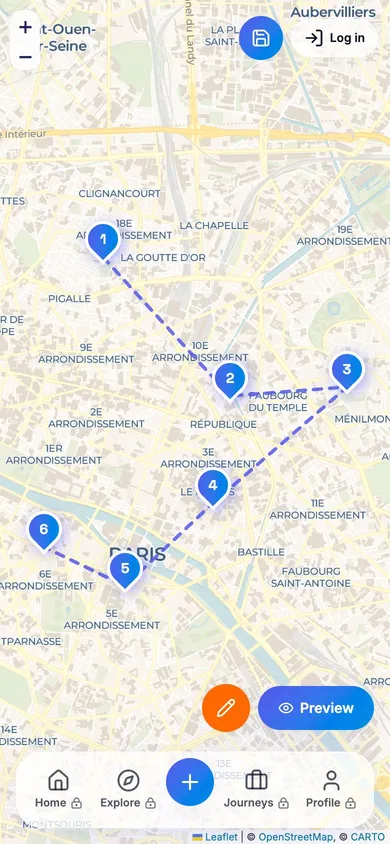
The metro is fast and covers the whole city, but Paris is best on foot. Pick one or two neighbourhoods per half-day, and use the metro to jump between them. Save the places you love as you go, so you can find them again or share them with friends heading to Paris.
Montmartre: beyond the Sacré-Cœur
Most visitors climb to the Sacré-Cœur and the Place du Tertre and leave. Instead, keep walking. The Rue de l'Abreuvoir and the Place Dalida are postcard-perfect, the Musée de Montmartre has gardens where Renoir painted, and there's even a small vineyard, the Clos Montmartre. Go early in the morning, before the crowds arrive.
Canal Saint-Martin: picnics and iron bridges
This canal in the 10th arrondissement is lined with plane trees and crossed by green iron footbridges. On sunny evenings, locals sit along the water with wine and cheese. Browse the independent shops and cafés along the Quai de Valmy and Quai de Jemmapes, and look for the Hôtel du Nord, made famous by a 1930s film.
Belleville: views, street art and food
Belleville is one of the most diverse parts of Paris, where Chinese, North African and Vietnamese restaurants sit side by side. The top of the Parc de Belleville has one of the best free views of the city, with the Eiffel Tower in the distance. Rue Dénoyez is covered in ever-changing street art, and the nearby Parc des Buttes-Chaumont has cliffs, a lake and a temple on a rock.
Le Marais: markets, museums and falafel
- Place des Vosges: the oldest planned square in Paris, ringed by red-brick arcades.
- Marché des Enfants Rouges: Paris's oldest covered market, dating from the 17th century, with stalls for lunch.
- Musée Carnavalet: the free museum of Paris history, in two grand mansions.
- Musée Picasso: one of the world's largest collections of Picasso's work.
- Rue des Rosiers: the heart of the old Jewish quarter, famous for its falafel.
The Latin Quarter: books, gardens and Roman ruins
- Shakespeare and Company: a legendary English-language bookshop opposite Notre-Dame.
- The Panthéon: where Victor Hugo, Marie Curie and other great figures are buried.
- Rue Mouffetard: a lively market street winding downhill.
- Arènes de Lutèce: the remains of a Roman amphitheatre, now a quiet square.
- Jardin des Plantes: botanical gardens, greenhouses and natural history galleries.
Saint-Germain-des-Prés: cafés and the Luxembourg Gardens
Saint-Germain is the classic Left Bank of writers and philosophers. Have a coffee at Café de Flore or Les Deux Magots (pricey but historic), see the frescoes in the church of Saint-Sulpice, and spend an afternoon in the Jardin du Luxembourg, where Parisians sit in the green metal chairs around the fountain and children sail toy boats.
A three-day neighbourhood plan
Day 1: the Eiffel Tower and the Seine in the morning, then Saint-Germain and the Jardin du Luxembourg. Day 2: the Louvre at opening time, then lunch in the Marais and an afternoon in its museums and boutiques. Day 3: Montmartre early, then the Canal Saint-Martin and sunset from the Parc de Belleville. Each day keeps you in neighbouring areas, so you spend more time exploring and less time on the metro.
Eating like a Parisian
- Buy bread from a boulangerie that displays the 'artisan boulanger' sign; try the city's best baguettes.
- Have a set lunch menu (formule) at a bistro; it's much cheaper than dinner.
- Picnic with cheese, bread and wine from a market.
- Order a café at the counter, where it costs less than at a table.
Practical tips
- Book the Louvre, the Eiffel Tower and Sainte-Chapelle online with a time slot.
- Use a contactless card or a Navigo Easy pass on the metro.
- Watch your bag in crowded places and on the metro.
- Many shops close on Sunday, but the Marais stays lively.
From Paris, take the train to Rouen and Mont-Saint-Michel with our Normandy itinerary, or fly south to the French Riviera.
Paris neighbourhoods checklist
- Montmartre early: Rue de l'Abreuvoir, Musée de Montmartre, the vineyard
- Evening picnic on the Canal Saint-Martin
- Sunset from the Parc de Belleville
- Lunch at the Marché des Enfants Rouges in the Marais
- Shakespeare and Company and Rue Mouffetard in the Latin Quarter
- An afternoon in the Jardin du Luxembourg
- Save your favourite cafés in recommendations
Frequently asked questions
What is the best neighbourhood to stay in Paris?
The Marais and Saint-Germain are central and walkable. Montmartre is charming but hilly, and Canal Saint-Martin is great for a more local feel.
Where can I see Paris without crowds?
Go early to Montmartre, and spend time in Belleville, the Canal Saint-Martin, the Jardin des Plantes and the Parc des Buttes-Chaumont.
How many days do you need in Paris?
Three to four days covers the main monuments and several neighbourhoods. A week lets you add Versailles and Giverny.
Is there a free view of Paris?
Yes. The Parc de Belleville, the steps of the Sacré-Cœur and the rooftop of the Galeries Lafayette department store all offer free views.
Sources
Start your next trip on a map.
Pin a few cities and see what a realistic route looks like — in five minutes, for free.
Open the plannerKeep reading
- Copenhagen Like a Local: Bikes, Harbour Baths, Street Food and HyggeCopenhagen beyond Nyhavn: swim in the harbour, cycle like a Dane, eat at a waterfront street-food market, explore Nørrebro and ski on a power plant.
- Things to Do in Edinburgh: Castles, Volcanoes and Hidden VillagesThe best things to do in Edinburgh: the castle and Royal Mile, a hike up Arthur's Seat, sunset on Calton Hill, Dean Village, Stockbridge and Leith.
- Things to Do in Kyoto: Temples, Gardens and How to Beat the CrowdsThe best things to do in Kyoto and when to go: Fushimi Inari at dawn, Kiyomizu-dera, Gion's evening streets, the bamboo grove and quieter temples.